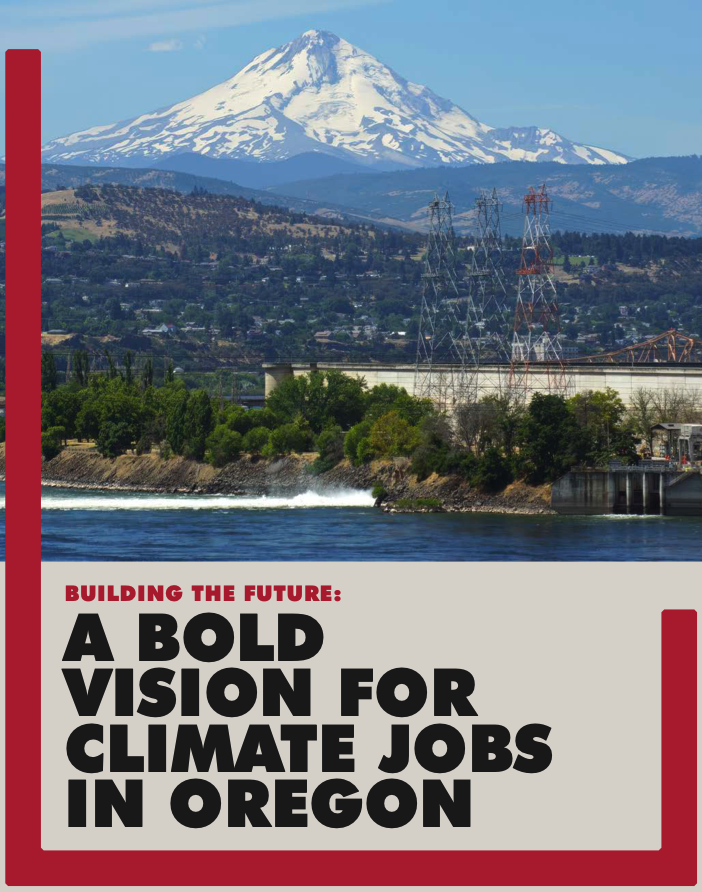
A Bold Vision for Climate Jobs in Oregon
Regions: State Wide
Solution Areas: Adaptation & Resilience Climate Justice Finance & Economy

The Climate Jobs Institute (CJI) at Cornell University’s School of Industrial and Labor Relations (ILR) conducted research and developed the report Building the Future: A Bold Vision for Climate Jobs in Oregon. We recommend reading the full report for a number recommendations within these five key themes:
- Comprehensive Gold Star Labor Standards for Oregon’s Green Union Transition
- Future-proofing Oregon’s Energy Grid and Industrial Economy, which provides a vision for scaling of Oregon’s renewable energy buildout, as well as the policies needed to get there. In addition, this section addresses emissions from the industrial sector, whose future is inextricably linked to that of the clean energy grid.
- Building Healthy & Resilient Communities, which focuses on strategies that guarantee the reduction of GHG and health-harming emissions where Oregonians live, work, learn, and play, prioritizing innovative models for ensuring equity and scaling work to guarantee high-road jobs take the place or low-road ones.
- Protecting Oregon’s Workers from Climate Impacts, which looks at strengthening protections and standards for those workers on the front lines of the climate crisis.
- Leading on Climate with Equity & High-Road Union Careers, which provides the framework for creating a diverse, equitable, and union clean energy workforce – from tightening enforcement of existing and future labor standards, to bolstering equitable workforce development, to ensuring public dollars lead to high-quality jobs.
About the Climate Jobs Institute
The Climate Jobs Institute at Cornell University’s ILR School is guiding the nation’s transition to a strong, equitable, and resilient clean energy economy by pursuing three aims: to tackle the climate crisis; to create high-quality jobs; and to build a diverse, inclusive workforce.
Through cutting-edge policy studies, deep relationships with on-the-ground partners, and innovative training and education programs, CJI provides information that policymakers, the labor and environmental movements, industry leaders, and others need to navigate this historic transition to a zero-carbon economy.