Understanding Decision Support for a Changing Climate
Regions: State Wide
Solution Areas: Adaptation & Resilience
Details
Text below from Aspen Global Change Initiative.
As climate change accelerates, practitioners, planners, and policymakers face increasingly complex decisions every day. Whether they’re helping communities prepare for rising seas, designing public health strategies to protect vulnerable populations from extreme heat, or redesigning transportation infrastructure to withstand more frequent flooding events, the stakes are high and the need for reliable, actionable climate information has never been greater.
To help address this challenge, AGCI launched a multi-year series of investigations to understand how over 400 practitioners across a range of sectors and settings access and use climate information in their work, and to identify how to better support their decisions and actions.
What is decision support?
At its core, decision support refers to the tools, processes, knowledge, and relationships that help people make informed choices—particularly when those choices are complicated by uncertainty, long time horizons, or multiple competing objectives. In the context of climate change, decision support can include everything from a regional workshop for water managers on climate resilience to localized sea level rise projections that inform coastal zoning plans to heat vulnerability maps that guide investments in cooling centers. More than just providing data, effective decision support is about delivering the right knowledge, in the most accessible way, to the people who need it, when they need it. It is also about how people work together and learn from each other.
Exploring real-world decision support needs

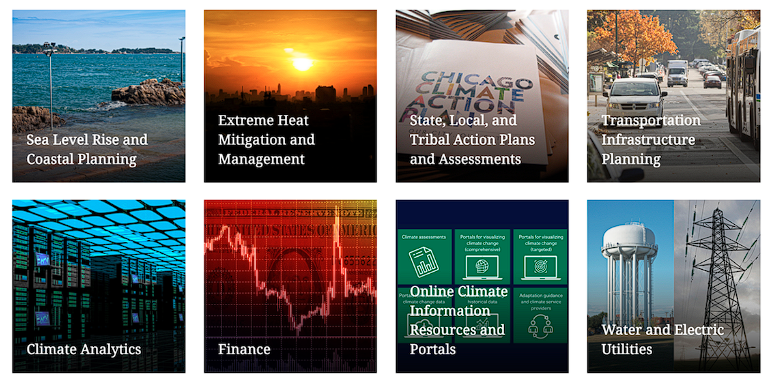
Starting in 2022, the AGCI project team embarked on investigations across a range of U.S. sectors, including sea level rise and coastal adaptation planning; extreme heat mitigation and management; state, local and tribal climate action planning; transportation infrastructure planning; climate analytics; financial services; and water and electric utilities. Through interviews, surveys, and document analysis, the project team gathered over 400 practitioner perspectives and reviewed hundreds of resources to illustrate what climate decision support looks like in different contexts and how decision making is affected by climate change — for business and industry, for government at all levels, and for individuals. The resulting report and project website present sector-specific insights as well as overarching findings, recommendations, and actions that bring together common themes across all eight investigations.
Read more HERE.